The apartment
Anxious PeopleThe apartment is a property viewing turned hostage scene, where the failed attempt to rob a bank spills into the lives of people gathered to look at a home. Its rooms hold both the comic confusion of the encounter and the material traces that later lead the police to question how the Bank robber disappeared. The apartment also sits within a wider housing market in which access to a home depends on money, credit, and the sale of property.
The viewing becomes a hostage scene
The crisis begins in the middle of an apartment viewing. The Bank robber, hesitant as the assembled people watch, struggles to say what she intends; Roger answers by explaining that they have no cash, and Anna-Lena immediately interprets his words for the room. The mismatch between the Bank robber’s apparent expectations and the viewers’ unhelpful candor gives the confrontation an absurd edge without diminishing its danger.
The bathroom door becomes the immediate focus when it is found locked. Julia urges the Bank robber to shoot the lock, but before she acts, the handle turns and a man wearing The rabbit head emerges, asking not to be shot and appealing to Anna-Lena. That unexpected appearance redirects the scene: the apartment’s hostage crisis becomes a story about a rabbit, and the locked bathroom proves to contain a concealed disruption rather than the threat the room had anticipated.
Rooms, objects, and the police search
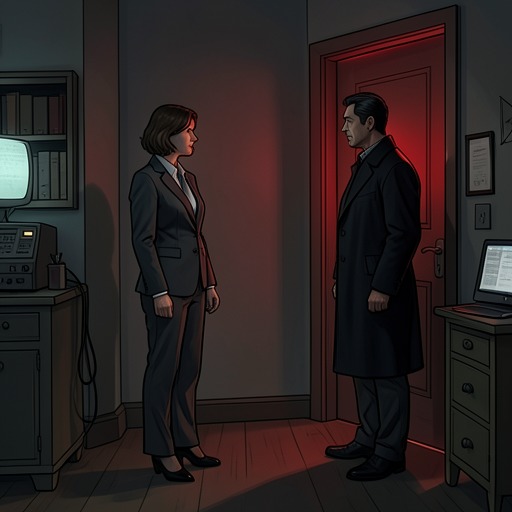
After the hostages have left, Jack and Jim retrace the apartment inch by inch, switching on their flashlights despite the ceiling lights already being on. The inventory is domestic and precise: a bowl of limes beside pizza boxes, glasses set on coasters, and a marker on the floor showing where police found The pistol. Beside the marker stands a small table with a small lamp. The orderly setting makes the marked spot, rather than any dramatic wreckage, the conspicuous trace of the crisis.
Jack asks where police found the phone they had sent in for the perpetrator. Jim says it was on the little table. The phone’s position becomes part of the officers’ reconstruction of the scene, connecting an ordinary piece of furniture to the unresolved question of what happened inside the apartment. The same rooms that had contained the hostage gathering are now being read as evidence.
The apartment is also treated as a setting whose occupants and status must be established. In a witness interview, Jack asks how many prospective buyers were present, and Zara challenges the category before he clarifies that he means the people who wanted to buy the property. The exchange shows how the viewing’s ordinary purpose persists in the official account even after the gathering has become a hostage incident.
A home within a housing market
The apartment’s significance extends beyond the crisis because the story places the viewing against the difficulty of securing housing without a job or savings. The Bank robber’s lack of a home is not an incidental detail: buying is beyond reach, while renting requires a substantial deposit. The viewing therefore brings together people encountering the apartment from sharply different positions—as a property to be bought, a setting in which to seek shelter, and the site of an emergency.
The distinction between a home and a saleable asset becomes especially visible when the Real estate agent lets slip that The neighboring apartment is also available. It lies opposite, across the elevator, resembles The apartment but has a slightly smaller closet, and is empty apart from a juicer. The owners are splitting up, and the agent admits that she has not yet advertised it because listing two properties at once could reduce the price of both. Where the hostage crisis has exposed how precarious a home can be for someone without resources, this adjacent sale exposes the agent’s calculation of apartments as competing assets.
Narrative significance
The apartment shifts from a place of anticipated purchase to a place of confinement, then to a scene examined for clues. Its ordinary details—coasters, food, a lamp, a phone—persist through those changes, making the police search feel less like an abstract investigation than a second reading of a lived-in room. The rabbit episode supplies a comic reversal within the crisis, while the later attention to the phone and the pistol’s marked location restores the unanswered practical stakes.
Set beside The neighboring apartment, the viewing property also anchors the book’s contrast between housing as a human need and housing as merchandise. One apartment gathers strangers into an emergency; the other is discussed in terms of its color, closet, mobile reception, and the seller’s preferred timing. Together, the spaces make the property market part of the story’s physical landscape rather than a distant economic backdrop.